


Claude Opus 4.6: New 1M Token Context & Agent Teams
Claude Opus 4.6 is here with a 1M token context window, Agent Teams for parallel coding, and SOTA benchmarks that outperform GPT-5.2 in professional workflows.

Claude Opus 4.6 Released: The New King of Agentic Coding and Knowledge Work
The AI landscape just shifted—again. Anthropic has officially pulled the curtain back on Claude Opus 4.6, and the benchmarks aren't just impressive; they're transformative. While the previous iteration, Opus 4.5, was already a heavyweight in the coding world, Opus 4.6 introduces a suite of features that move us closer to true autonomous "vibe working."
From a massive 1 million token context window to the revolutionary Agent Teams feature, this model is designed for high-stakes production environments where precision isn't optional. In this deep dive, we’ll explore the new capabilities, benchmarks, and real-world demos that make Opus 4.6 the current "state-of-the-art" (SOTA) champion.
The Headline Features: What’s New in Opus 4.6?
Claude Opus 4.6 isn't just a minor speed bump. Anthropic has re-engineered the way the model handles long-horizon tasks and complex reasoning.
1. The 1 Million Token Context Window
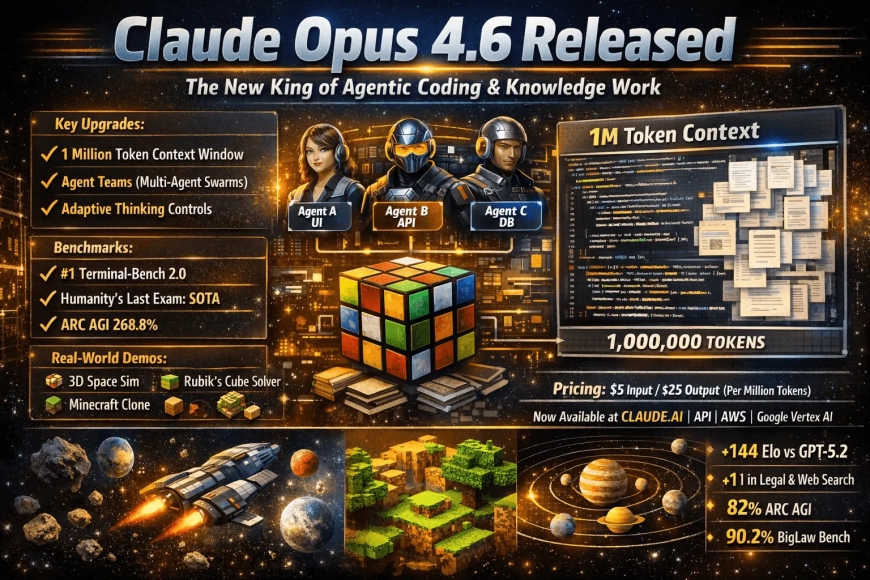
For the first time, an Opus-class model supports a 1 million token context window (currently in beta). To put that in perspective, you can now feed the model:
-
Over 30,000 lines of code.
-
More than 1,500 pages of technical documentation.
-
Entire repositories for a single refactoring task.
While competitors like Gemini 3 Pro also offer 1M tokens, Opus 4.6 boasts superior needle-in-a-haystack retrieval. On the MRCR v2 benchmark, Opus 4.6 scored 76% at 1 million tokens, while other models often see a significant drop in consistency at those lengths.
2. Agent Teams (Multi-Agent Swarms)
The most exciting addition for developers is Agent Teams within Claude Code. Instead of one AI working linearly, you can now spin up "swarms" of agents that work in parallel.
-
Agent A: Handles the frontend UI.
-
Agent B: Manages API routes.
-
Agent C: Performs database migrations and unit testing.
This parallel execution turns tasks that used to take 10–15 minutes into 2-minute "one-shot" successes.
3. Adaptive Thinking & Effort Controls
Anthropic has moved away from a simple binary "thinking mode." Opus 4.6 uses Adaptive Thinking, allowing it to decide for itself when a problem requires deep reasoning. Developers can manually tune this using the new Effort Parameter (Low, Medium, High, Max) to balance latency and cost.
Performance Benchmarks: Dominating the Competition
Opus 4.6 has claimed the top spot across several critical evaluations, effectively leapfrogging GPT-5.2 and Gemini 3 Pro in specialized tasks.
| Benchmark | Opus 4.6 Score | Notable Competitor |
| Terminal-Bench 2.0 | #1 Rank | Leads in Agentic Coding |
| Humanity’s Last Exam | SOTA | Complex Multidisciplinary Reasoning |
| ARC AGI 2 | 68.8% | Major leap in reasoning |
| BigLaw Bench | 90.2% | Outperforms GPT-5.2 in Legal |
| BrowseComp | #1 Rank | Superior Agentic Web Search |
Key Takeaway: Opus 4.6 beats GPT-5.2 by 144 Elo points on the GDPval-AA knowledge-work benchmark, solidifying its place as the smartest model for professional enterprise workflows.
Real-World Demos: From 3D Games to Enterprise Apps
The video transcript highlights several impressive demos that showcase the model's ability to move beyond "AI slob" (generic, messy code) to premium-quality outputs.
-
3D Space Simulation: Created with a single command, featuring a functional mini-map, variable speed, and coin collection mechanics.
-
3D Rubik’s Cube: A fully functional simulation that can not only be scrambled but also solved by the AI itself.
-
Minecraft Clone: A stunning one-shot generation featuring multiple terrains, dynamic movement, and block-breaking physics.
-
Solar System Visualizer: A long-context masterpiece that included every planet, their specific moons, and dynamic orbital animations.
-
The "Butterfly" SVG: In a head-to-head with Grok 4.1, Opus 4.6 not only generated the vector art faster but automatically added sophisticated animations without being asked.
Pricing and Availability: Is It Worth the Cost?
Quality comes at a price. Opus 4.6 remains one of the most expensive models on the market.
-
Input Tokens: $5 per million tokens.
-
Output Tokens: $25 per million tokens.
-
Long Context (Beta): Prompts exceeding 200k tokens are charged at a premium rate ($10/$37.50).
How to Access:
-
Claude.ai: Available for Pro, Team, and Enterprise subscribers.
-
API: Available via Anthropic's Developer Platform, Amazon Bedrock, and Google Vertex AI.
-
Third-Party: You can use it via Open Router or Kilo Code.
-
Tip: Kilo Code often provides a $25 credit for new users to test the API.
-
Tip: Existing Claude subscribers can claim a free $50 credit in their usage settings to test Opus 4.6.
-
The Verdict: A Pivot to "Vibe Working"
Anthropic is clearly positioning Opus 4.6 as the "brain" for the next generation of AI agents. By integrating directly into tools like Excel and PowerPoint, and offering the reliability needed for Cybersecurity and Financial Analysis, they are moving away from simple chatbots toward autonomous teammates.
If your work involves deep research, massive codebases, or complex planning, Opus 4.6 is currently the most capable tool in your arsenal. For lighter tasks, pairing it with the faster, cheaper Sonnet 4.5 remains the best strategy for balancing performance and budget.
What's Your Reaction?
 Like
0
Like
0
 Dislike
0
Dislike
0
 Love
0
Love
0
 Funny
0
Funny
0
 Angry
0
Angry
0
 Sad
0
Sad
0
 Wow
0
Wow
0